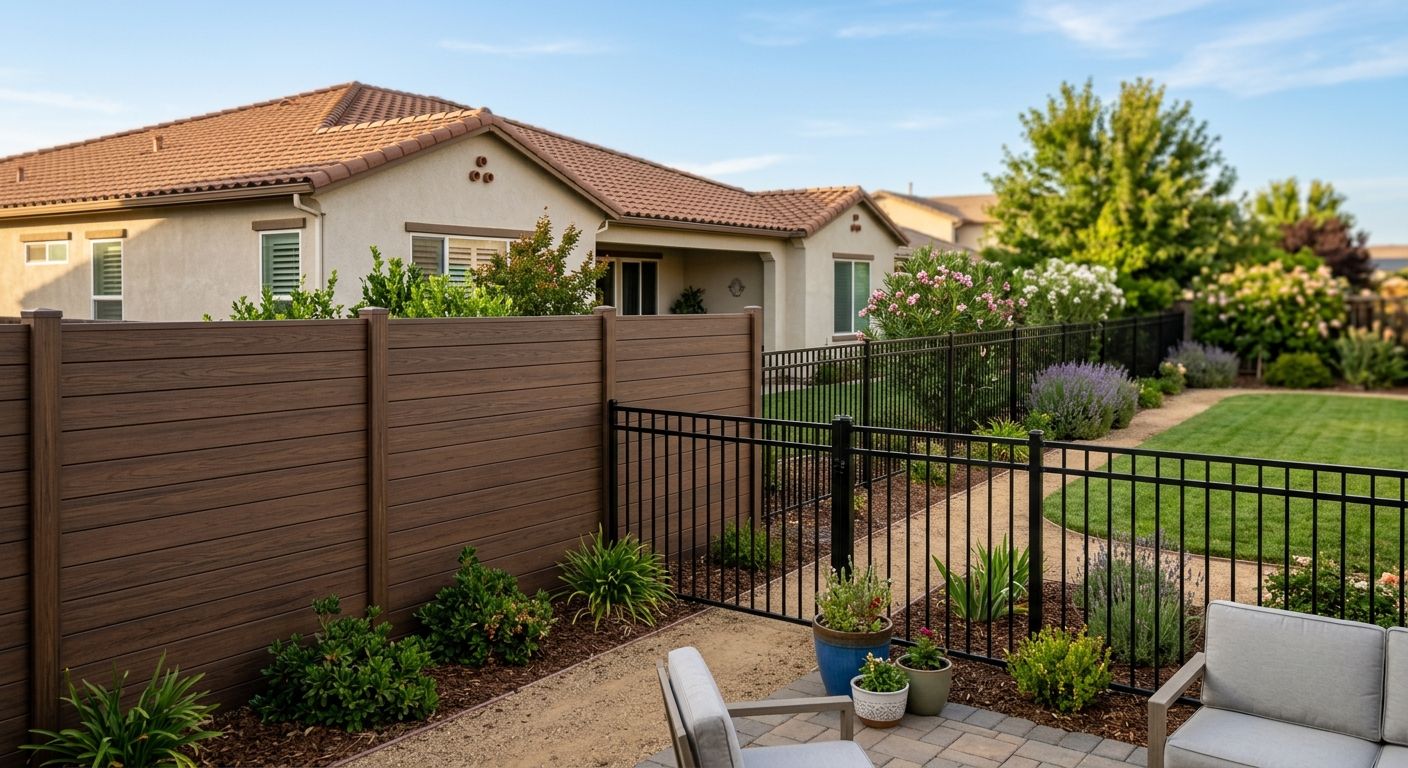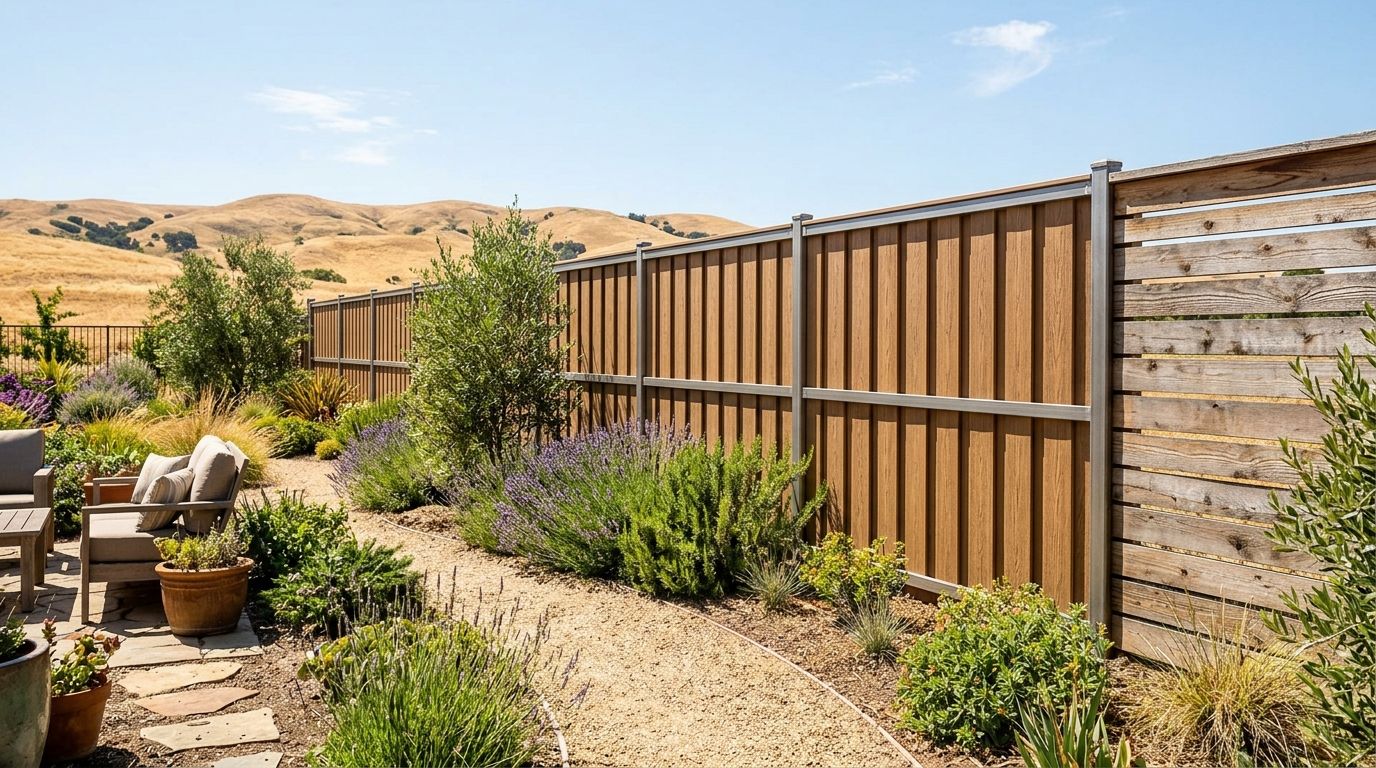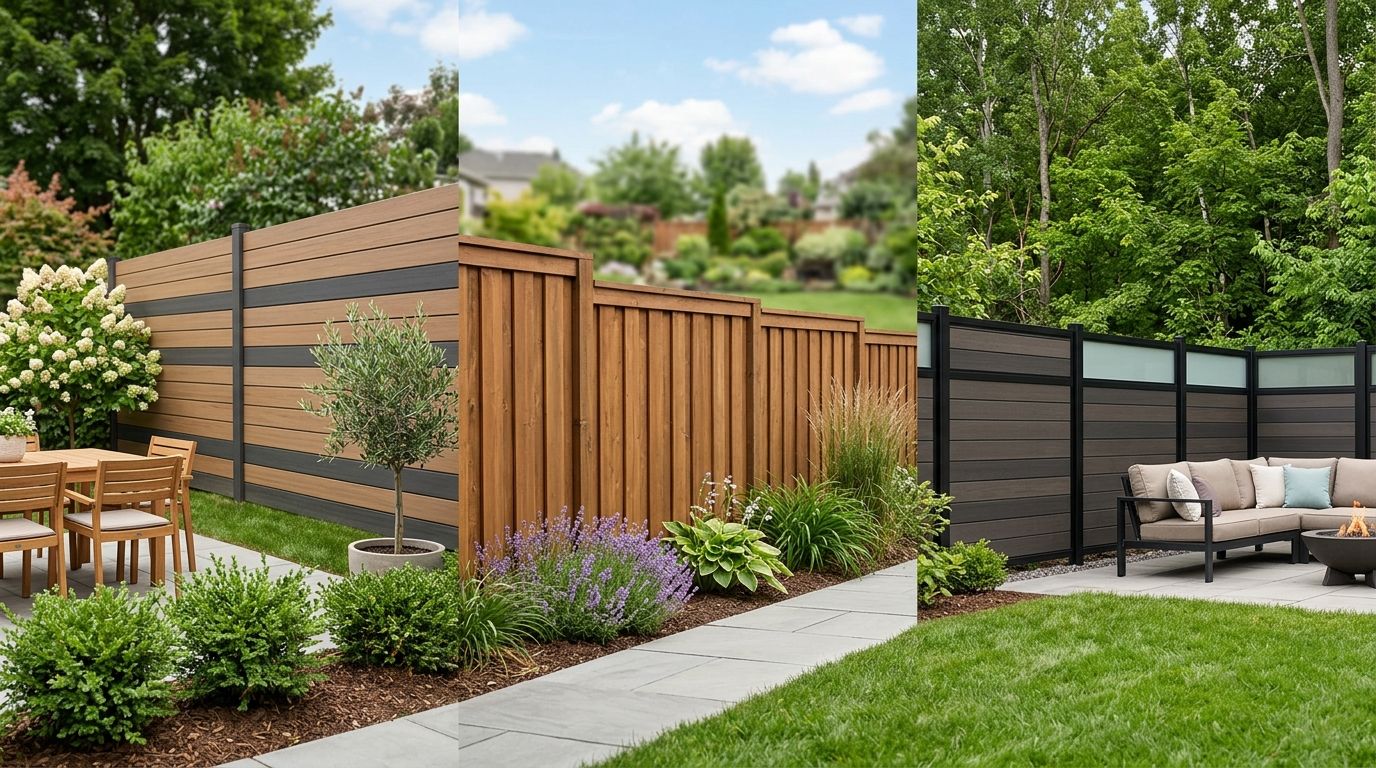
Central Valley backyards need a fence that blocks sightlines, breaks the wind, and doesn't cup or twist through a 100-degree Modesto summer. Here's how the five privacy fence styles homeowners in Modesto, Manteca, and Turlock actually build in 2026 compare, style by style.
- Board-on-board fencing is the best overall privacy fence style for Central Valley wind and heat in 2026.
- Standard dog-eared privacy fencing is the best budget option for straightforward backyard privacy.
- Shadowbox fencing gives both neighbors a finished side and lets airflow move through hot summer nights.
- Lattice-top privacy fencing adds height on HOA-restricted lots without extra solid fence footage.
- California Crews backs every privacy fence style with a 5-year warranty and a 3-5 day install turnaround.
Why this matters
Most fence guides rank styles by looks alone. In Modesto, Manteca, and Turlock, the style you pick also has to survive triple-digit heat, dry wind events, and posts set in valley clay that shrinks and swells. California Crews has built privacy fences across the Central Valley since 2001, and the style that looks best in a photo isn't always the one that's still straight in five years.
The five styles below cover every common backyard scenario in 2026: tight budgets, shared fence lines with picky neighbors, HOA height caps, and high-wind lots. Each one gets a direct verdict, not a vague recommendation.
Best overall: board-on-board fence. Best budget option: standard dog-eared privacy fence. Best for shared fence lines: shadowbox fence. Best for HOA height limits: lattice-top privacy fence. Best for modern curb appeal: horizontal privacy fence.
What makes the best privacy fence style
- Wind performance — how well the panel style handles gusts without racking or bowing
- Heat and UV durability — resistance to cupping, warping, and gaps opening as boards dry out
- Actual privacy level — how much sightline gets blocked, not just implied
- HOA and code fit — whether the style works within typical height and appearance rules
- Cost and turnaround — lumber used per linear foot and days on site
- Curb appeal from both sides — how the fence reads to you and to the neighbor
Privacy fence styles at a glance
| Style | Best for | Standout feature | Key limitation |
|---|---|---|---|
| Board-on-board | Wind resistance | Overlapping boards on both faces | Uses more lumber, heavier install |
| Standard dog-eared | Budget | Fastest, most affordable build | One side shows the rails |
| Shadowbox | Shared fence lines | Identical finish on both sides | Gaps mean partial visibility |
| Lattice-top | HOA height limits | Adds height without extra solid footage | Lattice section isn't fully private |
| Horizontal | Modern curb appeal | Clean contemporary board lines | Needs extra internal framing |
1. Board-on-board fence: best privacy fence style for wind resistance
Board-on-board alternates overlapping boards across both faces of the rail, so there's no single flat plane catching every gust head-on. That overlap is also what keeps the fence fully opaque from either side, which matters more once a Central Valley wind event kicks up dust and debris in spring and fall.
Board-on-board pros:
- Full privacy on both sides of the fence line
- Handles Central Valley wind gusts better than flat single-layer panels
- Higher resale and curb appeal than basic privacy styles
- Holds up longer when posts are set at proper depth
Board-on-board cons:
- Uses more boards per linear foot, so material cost runs higher
- Heavier fence line means deeper post holes and more concrete
- Takes longer to install than a standard panel run
Verdict: Build it. This is the default recommendation for most Modesto and Manteca backyards in 2026, and it's the style California Crews points wind-exposed lots toward first.
2. Standard dog-eared privacy fence: best budget option
Standard privacy fencing butts boards edge to edge on a single rail side, with a dog-eared board top for a finished look. It's the most common residential fence style in the Central Valley because it's fast to build and uses less lumber than double-sided styles.
Standard privacy pros:
- Lowest material cost of the five styles
- Fastest install turnaround
- Widely available lumber, so repairs are simple later
Standard privacy cons:
- One side shows exposed rails, which some neighbors don't love
- Boards can gap as cedar or Douglas fir dries out in summer heat
- No wind relief built into the design, so more surface area catches gusts
Verdict: Build it if budget drives the decision. It's a solid, no-frills fence — just expect a rail-facing side on one property line.
3. Shadowbox fence: best for shared fence lines and neighbor relations
Shadowbox alternates boards on opposite sides of the rail with a small gap between them, so both properties see the same finished pattern. Air moves through the gaps instead of slamming against a solid wall, which helps yards cool down faster once the sun drops.
Shadowbox pros:
- Identical, finished appearance on both sides of the fence
- Lower wind load than a fully solid fence
- Better airflow through hot Central Valley evenings
Shadowbox cons:
- Small gaps mean partial visibility, not true privacy
- Doesn't satisfy HOA rules that require full visual screening
- Gaps can widen slightly as boards dry and shrink
Verdict: Build it for shared property lines where both households want a matching fence. Skip it if total visual privacy is the actual goal.
4. Lattice-top privacy fence: best for HOA height limits
Lattice-top takes a solid privacy fence to standard height and adds an open lattice topper above it, typically 12 to 18 inches. Many HOAs and local codes measure solid fence height separately from open lattice, which makes this style a common workaround for lots capped below what full privacy would need.
Lattice-top pros:
- Adds height and screening without extra solid footage
- Decorative topper improves curb appeal on plain fence runs
- Lets some light and air through the top section
Lattice-top cons:
- The lattice section itself isn't fully private
- Thinner lattice slats crack faster under high UV than solid boards
- Extra trim work adds install time
Verdict: Consider it if your lot line has a height cap. Skip it if maximum privacy at every level of the fence matters more than height.
5. Horizontal privacy fence: best for modern curb appeal
Horizontal fencing runs boards side to side across the posts instead of vertically, a look that's become common on newer and remodeled Central Valley homes. Tightly spaced horizontal boards still block sightlines completely — the difference is entirely visual.
Horizontal fence pros:
- Distinct, contemporary look that stands out from standard vertical runs
- Pairs well with metal or composite posts for a cleaner line
- Fully private when boards are set tight
Horizontal fence cons:
- Needs internal blocking to keep long spans from sagging
- More labor-intensive to frame than a vertical fence
- Fewer crews build it well, so experience matters more here
Verdict: Build it for a design-forward remodel. Skip it if keeping the budget tight is the priority — vertical styles cost less to frame.
Get a Privacy Fence Quote in Modesto
No deposit required, no obligation, 3-5 day turnaround.
How we ranked these privacy fence styles
Each style was weighed against the six criteria above: wind performance, heat and UV durability, actual privacy level, HOA fit, cost and turnaround, and curb appeal from both sides of the line. Board-on-board came out on top because it's the only style that scores well on wind, privacy, and durability at once — the other four each trade one of those for cost, airflow, or height flexibility.
Which privacy fence style should you choose in 2026?
If you're not sure where to start, board-on-board is the default answer for most Central Valley backyards — it handles wind, holds privacy, and ages well in the heat. Drop to standard dog-eared privacy if the budget is the deciding factor, move to shadowbox if a neighbor wants input on the fence line, and go lattice-top or horizontal only when a height cap or a design goal makes one of those the clear fit. California Crews carries a 5-year warranty, license #909718, and $2M in insurance on every privacy fence style listed here, with 25+ years building them across Modesto, Manteca, Turlock, and Ripon.
FAQ
What's the best privacy fence style for Central Valley wind?
Board-on-board is the best privacy fence style for wind resistance because overlapping boards on both faces reduce the flat surface area catching a gust. Standard single-layer privacy panels take more direct wind load.
Is board-on-board fencing more expensive than standard privacy fencing?
Board-on-board runs more expensive because it uses more boards per linear foot and requires deeper post holes for the added weight. Standard dog-eared privacy fencing is the cheaper option of the two.
Do shadowbox fences provide full privacy?
No, shadowbox fences leave small gaps between alternating boards, so they block most but not all sightlines. Choose board-on-board or standard privacy fencing if total visual privacy is the requirement.
Can I add a lattice topper to any privacy fence style?
A lattice topper works on most privacy fence styles and is most often paired with a solid board run to add height without extra solid footage. It's a common fix for lots with a fence height cap.
How long does it take to install a privacy fence in Modesto?
A typical residential privacy fence installs in 3-5 days depending on linear footage and style, with board-on-board and horizontal fencing taking longer than standard dog-eared privacy fencing.
Which wood holds up best for a privacy fence in the Central Valley?
Redwood, cedar, and Douglas fir are the standard fencing woods used in the Central Valley because they resist warping better than untreated pine under sustained summer heat. Post depth and spacing still matter as much as the wood species.
Is a horizontal privacy fence more expensive to build than a vertical one?
Yes, horizontal privacy fences generally cost more to install because the boards need internal blocking to prevent sagging across long spans. Vertical styles like standard or board-on-board frame faster with less labor.
One last thing
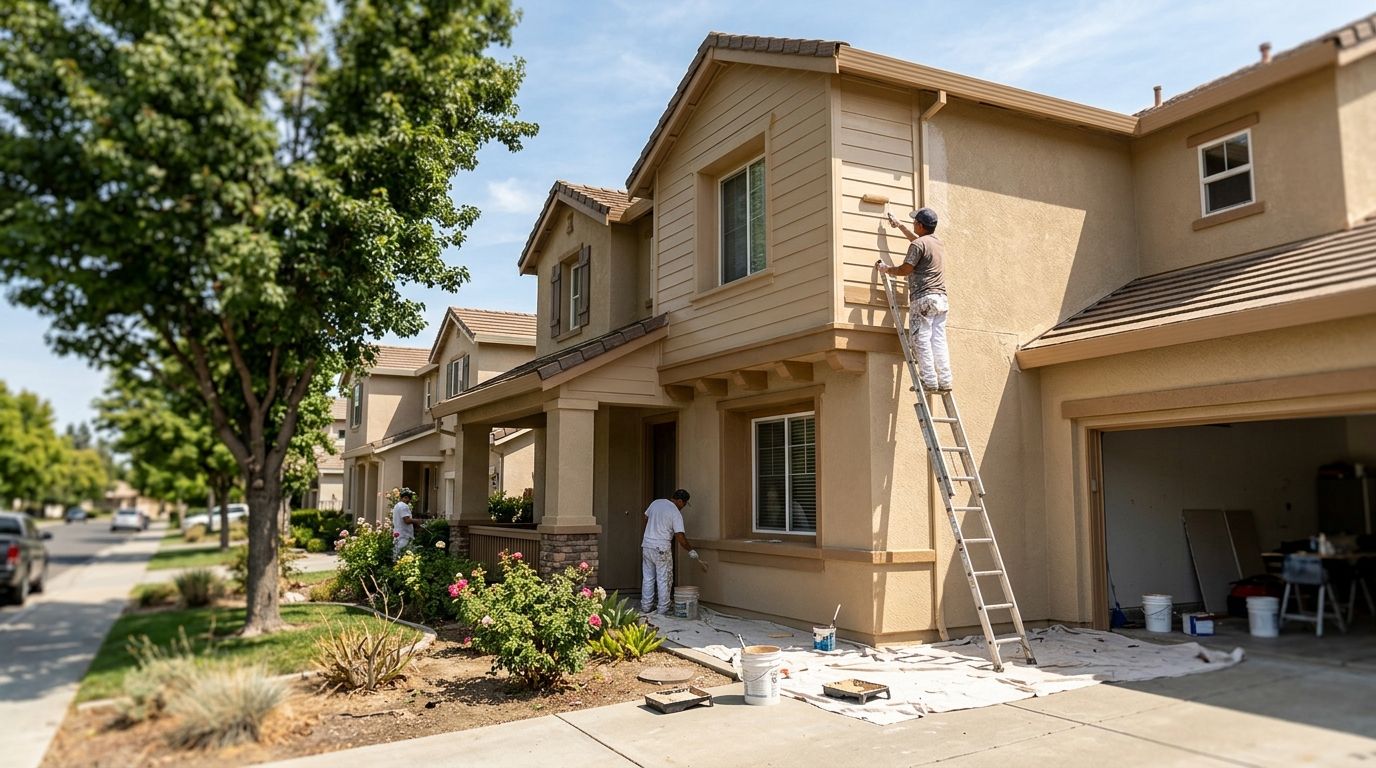
A brand-new fence has a way of making old exterior paint look worse by comparison — the contrast shows every chalked-out wall and peeling trim board within a week. If a fence project is already on the calendar for 2026, it's worth checking exterior house painting costs in Modesto before locking in a fence stain color, since matching the two at once saves a second round of color decisions later.